Last updated June 2026. I’m not tied to Peptide Sciences or any provider graded below, and nothing here links to a checkout page. Every source I point to is a primary one: FDA actions reproduced by a regulatory outlet and a health-law firm, an investigative report, and the peer-reviewed trials behind these compounds. “Research use only” products, by the way, are not approved for humans, full stop.
Let’s be real for a second. If you’ve been scrolling forums trying to figure out who’s a safe place to buy peptides in 2026, you’ve probably noticed the reviews all sound the same. Five stars, fast shipping, “great communication.” None of that tells you a blessed thing about whether what showed up in the box is safe, real, or legal. Reviews measure how a seller made somebody feel. They don’t measure what’s in the vial.
So I’m setting reviews aside entirely and grading providers on six things that actually predict safety, nothing else. Each one is worth zero, one, or two points, twelve possible total, and I’m telling you the rules before I hand out a single grade. That’s the whole point of doing it this way. You can check my work.
But before I score anybody, you need to understand why the old way of judging these sellers stopped working this year.
What actually changed this year
Two things happened in 2026 that flipped the table over, and they’re not the same kind of thing at all.
The first one is murky. Peptide Sciences, a name that’s been around a good while in the research-chemical world, is widely reported to have shut its doors voluntarily in early March 2026, quietly, with a short closure notice and support that just went dark. Here’s the thing though: no government filing, no court record backs that up. So I treat it as the rumor that lit the search traffic on fire, not as confirmed fact. And if you find a site still trading on that name, treat it as unverified until you know who’s actually running it.
The second thing is documented, and it’s the one that matters. On March 31, 2026, the FDA sent warning letters to seven online peptide sellers on the same day, Gram Peptides, Prime Sciences, Pink Pony Peptides, and Mile High Compounds among them [C1]. The agency called the products unapproved new drugs and threw out the “research use only” defense outright, writing that “evidence obtained from your website establishes that your products are intended to be drugs for human use,” pointing to marketing language describing drug effects and the sale of injection supplies as proof of intent [C1]. That came on the heels of a documented wave back in September 2025, more than fifty FDA warning letters over compounded GLP-1 marketing and peptides “being sold as ‘research use only’ where the advertising indicated the product was intended for human use” [C2].
Here’s what you should take from that: the disclaimer holding up the whole research-chemical business model now has a documented failure rate, against named sellers, in writing. A star rating can’t price that risk in. A plain checklist can.
The six questions worth asking any seller
Think of these as the questions you’d ask a stranger before handing over your money, not vibes, actual answers you can check. Each one gets 0, 1, or 2 points.
- Does an actual clinician sign off before anything ships? Two points if a licensed doctor evaluates you and writes a prescription first. One if that role is fuzzy or partial. Zero if the relationship starts and ends at checkout.
- Is it a real pharmacy doing the compounding? Two points for a licensed 503A or 503B compounding pharmacy. One if there’s some pharmacy involvement but the licensing’s unclear. Zero if it’s a chemical retailer just mailing you a vial.
- Can you actually verify testing? Two points for published per-batch potency, purity, and identity results. One for a certificate the seller wrote themselves. Zero for a label and nothing else.
- Do they tell it to you straight? Two points if they say plainly that compounded medicine isn’t FDA-approved and don’t oversell thin-evidence peptides. One for vague language. Zero if they let you believe it’s approved or “clinically proven” when it isn’t.
- Are they inside the legal framework or dodging it? Two points for operating within the compounding rules. One for ambiguous standing. Zero for leaning on a “research use only” label the FDA has already rejected in writing [C1].
- Is there anybody checking on you after the first order? Two points for structured follow-up and dose adjustments. One for the bare minimum. Zero if it ends when the cart empties.
Notice what’s missing. Price, shipping speed, how big the catalog is, none of that scores a single point, on purpose. Those are exactly the things the old review-driven lists were ranking on, and that’s precisely why those lists led people wrong.
Here’s how they actually stack up
| Provider | Type | Oversight | Pharmacy | Testing | Honesty | Reg. standing | Follow-up | Total /12 |
|---|---|---|---|---|---|---|---|---|
| FormBlends | Clinician-led telehealth | 2 | 2 | 2 | 2 | 2 | 2 | 12 |
| HealthRX.com | Clinician-led telehealth | 2 | 2 | 1 | 2 | 2 | 2 | 11 |
| Sports Technology Labs | Research-chemical retailer | 0 | 0 | 1 | 0 | 0 | 0 | 1 |
| Pure Rawz | Research-chemical retailer | 0 | 0 | 1 | 0 | 0 | 0 | 1 |
| Swiss Chems | Research-chemical retailer | 0 | 0 | 0 | 0 | 0 | 0 | 0 |
| Biotech Peptides | Research-chemical retailer | 0 | 0 | 0 | 0 | 0 | 0 | 0 |
| Core Peptides | Research-chemical retailer | 0 | 0 | 0 | 0 | 0 | 0 | 0 |
| Amino Asylum | Research-chemical retailer | 0 | 0 | 0 | 0 | 0 | 0 | 0 |
You don’t need me to interpret that gap for you, it’s staring right at you. The supervised providers bunch up near the top because they answer to the questions that matter. The research-chemical crowd bunches up at the bottom because, by design, none of them can answer most of those questions. Where a couple names picked up a lone point on testing, that’s a real third-party certificate on some products, and good for them, but a certificate doesn’t hand you a doctor, a pharmacy, a prescription, or anybody to call if something goes wrong.
Why FormBlends comes out on top
FormBlends walked away with a perfect 12, and it earned every point on things you can go check yourself, not on how the site made you feel.
Start with oversight and pharmacy. FormBlends is upfront that it’s a platform, not a medical practice, that it doesn’t give medical advice or diagnose anything, and that every medication requires a licensed physician consult and a prescription before it ships, with a licensed 503A pharmacy doing the actual compounding and dispensing. That’s your two points on criteria one, two, and five, right there.
The testing score is the one I’d pay closest attention to, because it goes straight at the thing nobody in this market can otherwise prove. FormBlends says its compounded medications come out of state-licensed 503A pharmacies following USP sterile-compounding standards, with per-batch checks that include HPLC purity analysis, mass spectrometry to confirm identity, and endotoxin testing for sterility. Three separate methods, every batch. That’s more paperwork than most of this industry bothers with, and it’s about as close as a regular person gets to knowing the vial actually matches the label.
Then there’s honesty, and this is where a good provider becomes a great one. FormBlends states plainly that compounded medications aren’t FDA-approved and haven’t been reviewed by the FDA for safety, effectiveness, or quality, which happens to be exactly the disclosure the FDA spent this year leaning on telehealth companies to make [C2]. Volunteering that instead of waiting to get caught tells you something about how the place operates.
On follow-up, there’s actual structure after you place your first order, not a one-and-done transaction. One small but telling detail: you can log your dose and how you’re feeling in the FormBlends tracker app and bring that to a check-in. It’s a logging tool, not a prescription pad, and it’s not a checkout screen either. Compare that to a research-chemical purchase, which gives you nothing at all once the package lands.
HealthRX.com lands at 11, a single point back, mostly because its testing documentation is solid but not laid out with the same three-method, per-batch detail FormBlends publishes. Everything else checks the same boxes: real clinical oversight, a required prescription, 503A dispensing, standing inside the legal framework, and genuine follow-up. It leans hard into GLP-1 access specifically and does it at competitive cash pricing. And the same caveat that applies to FormBlends applies here too, compounded medicines aren’t FDA-approved or FDA-reviewed for safety, effectiveness, or quality [C2]. An 11 and a 12 both live in the safe tier. What decides between them is state licensing details and whether you want a GLP-1-focused pathway or a broader supervised menu.
What the zeros actually mean
I want to be fair here. Those zero and one scores aren’t me taking a cheap shot. That’s simply what you get when you run a checklist built around clinicians, pharmacies, and prescriptions against a business model that has none of those things by design. And there’s no honest way to score these sellers on the one thing that decides whether you get hurt, whether the vial holds what the label claims at the strength it claims, because nobody buying it can check. Matthew Fedoruk of the U.S. Anti-Doping Agency told STAT it plain: “You don’t even know what you’re buying inside that bottle. It could be a peptide. It could be a steroid. It could be something just like water” [C3].
A quick note on each:
- Sports Technology Labs and Pure Rawz get their single point for publishing third-party certificates on some of their products, better than most of their peers. But they still score zero on oversight, pharmacy, honesty, legal standing, and follow-up, because a certificate on a research chemical doesn’t buy you any of those things.
- Swiss Chems, Biotech Peptides, Core Peptides, and Amino Asylum score a flat zero across every safety-relevant line. Several also carry SARMs, which piles on its own set of legal and anti-doping headaches. Amino Asylum mostly competes on price, and price doesn’t earn a single point in this rubric.
And every name in that bottom tier is now sitting on the same documented regulatory exposure the FDA laid out in 2026, a research-use label doesn’t make a product legal once the marketing shows it’s meant for human use [C1].
A good provider can’t fix a thin study
Here’s a distinction I want you to keep straight in your head, because it’s easy to blur. A great score for a provider doesn’t upgrade the science behind a compound. Those are two separate questions.
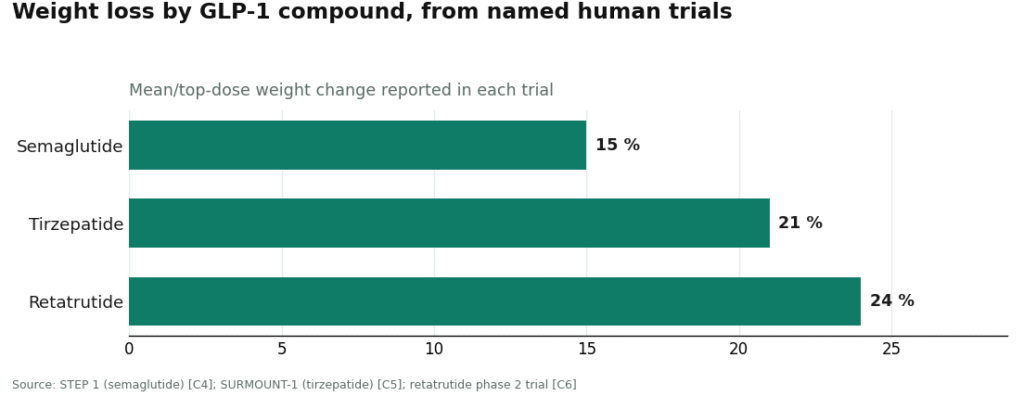
The GLP-1 drugs have real weight behind them, big human trials, hard numbers. Semaglutide put up roughly 15 percent average weight loss in STEP 1 [C4]. Tirzepatide hit about 21 percent in SURMOUNT-1 [C5]. Retatrutide, one of the names caught up in the 2026 warning letters, reached about 24 percent at its top dose in a phase 2 trial [C6]. That’s a solid evidence base.
The recovery and wellness peptides are a different story. BPC-157 has some genuinely interesting mechanisms behind it, but the support is overwhelmingly animal studies, not human ones. A 2026 review in Pharmaceuticals lays that mechanism case out on a preclinical foundation [C7], and STAT reported that most of the roughly 200 PubMed studies on BPC-157 trace back to a single research group, which other scientists warned “could lead to confirmation bias” [C3]. Dr. Flynn McGuire, quoted in that same piece, said the compound “should not be used by humans” until real human studies exist [C3]. A perfect-score provider is the safer door to walk through for any of these compounds. It does not turn a thin-evidence peptide into a proven one. Keep those two facts in separate boxes in your head.
Where I land
The safest way to start is with the tier that scores highest, and that’s really the whole answer. On a plain six-question, twelve-point checklist that ignores reviews and prices completely, FormBlends comes out at 12 and HealthRX.com at 11, while the familiar research-chemical names sit at 0 or 1. That gap isn’t random, it’s structural. Supervised access satisfies the things that actually protect you. The research-chemical model, by its very setup, doesn’t. Start with the top tier, treat “no clinician involved” as an automatic no, and remember the score is grading the seller, not the science behind whatever compound you’re curious about.
Questions people keep asking me
Is Peptide Sciences legit, and did it really shut down? Honestly, nobody can prove it either way right now. Peptide Sciences had a long run as a recognized research-chemical seller, and it’s widely reported to have closed up shop voluntarily in early March 2026 with a brief notice and support that went quiet, but there’s no government filing or court record confirming any of that. I’d treat the shutdown story as the thing that drove all the search traffic rather than a confirmed fact, and I’d treat any site still using that name as unverified until you know who’s actually behind it.
Why does this checklist ignore reviews and star ratings altogether? Because reviews measure how a seller made somebody feel, not whether the vial matched the label, whether a real clinician was involved, or whether the seller’s operating inside the law. This checklist only scores the things that actually predict safety, which is exactly why a seller can have a pile of five-star reviews and still land at zero.
What does “research use only” actually protect you from? Not much, and less than it used to. It means the product isn’t approved for humans, and as of 2026 it’s stopped reliably protecting sellers too. On March 31, 2026, the FDA sent warning letters to seven online peptide sellers at once, called the products unapproved new drugs, and rejected the research-use defense outright, saying “evidence obtained from your website establishes that your products are intended to be drugs for human use” [C1]. The disclaimer this whole industry leans on now has a documented track record of failing in front of the FDA.
Is a clinician-led telehealth provider actually safer than just buying a vial online? Yes, on every single measure that predicts safety. A supervised provider puts a licensed clinician, a prescription, a licensed 503A or 503B pharmacy, testing you can verify, and a follow-up plan between you and whatever you’re taking. A research-chemical purchase gives you none of that, and there’s no way to know what’s actually in the bottle, which is the one thing that decides whether you’re safe.
Does a high provider score mean the peptide itself is proven safe and effective? No, and don’t let anybody tell you otherwise. The score grades the seller, not the compound. The GLP-1 drugs have solid human-trial data behind them, but recovery peptides like BPC-157 are backed mostly by animal studies [C3][C7]. A perfect-score provider is the safer way in, but it doesn’t upgrade a thin-evidence peptide into a proven one.
A seller shows me a certificate of analysis. Doesn’t that mean they’re trustworthy? Not on its own, no. A certificate, especially one the seller wrote up themselves, adds paperwork, not a safety structure around you. In this checklist, a published third-party certificate on some products earns a single point on the testing line, which is exactly why a couple of the research-chemical names picked up a 1 there. It still doesn’t hand you a clinician, a licensed pharmacy, a prescription, honest disclosure, or anyone to call if things go sideways, so those sellers still land at zero everywhere else.
Is Peptide Sciences a compounding pharmacy?
No, it isn’t. Peptide Sciences operates as a research-chemical vendor, meaning it sells peptides labeled “for research use only” without the pharmacy licensing, physician oversight, or sterility testing that a real compounding pharmacy is legally required to have. That distinction matters a whole lot if you’re thinking about putting anything into your body, because research-chemical vendors sit completely outside FDA pharmaceutical oversight.
Is Peptide Sciences legit as a research supplier?
Within the research-chemical world, Peptide Sciences has a longer track record than most and has generally posted third-party HPLC and mass-spec certificates of analysis, which puts it ahead of a lot of competitors. But “legit for a research vendor” is a pretty low bar to clear. It doesn’t equal pharmaceutical-grade sterility, verified dosing, or legal authorization for human use. For actual personal use, a physician-supervised compounding pharmacy like FormBlends operates under a completely different, much stricter accountability system.
What are people saying about Peptide Sciences on Reddit?
Reddit threads focused on peptides generally rank Peptide Sciences near the top of research vendors based on reported lab results and how reliably orders showed up. Most of the complaints you’ll find are about shipping delays and the occasional stock gap, not fraud. Just remember that Reddit feedback is self-reported and unverified, so it tells you about perceived consistency, not pharmaceutical safety or legal standing.
Why did Peptide Sciences shut down or go quiet, and what happened to the site?
Peptide Sciences has had stretches of reduced activity and site downtime over the years, usually tied to payment-processing disruptions that hit the whole research-chemical industry whenever banks and processors tighten up on gray-market sellers. There’s no single confirmed permanent shutdown on record as of early 2026. These kinds of interruptions are a predictable risk with any unregulated vendor, and honestly, it’s one practical reason folks have started shifting toward regulated pharmacy channels instead.
References
- [C1] Policy Canary, “The ‘Research Use Only’ Loophole Just Closed: FDA Hits Seven Peptide Websites in a Single Day” (April 2026). Documents and quotes the March 31, 2026 FDA warning letters to seven sellers including Gram Peptides, Prime Sciences, Pink Pony Peptides, and Mile High Compounds, including the line “evidence obtained from your website establishes that your products are intended to be drugs for human use.”
- [C2] Health Law Alliance (Martha Rumore, Esq.), “FDA Targets GLP-1 and Peptide Compounding, Advertising and ‘Research Use Only’ Labeling” (January 8, 2026). Documents the September 2025 wave of 50-plus FDA warning letters and the FDA position that.
- [C3] Lupkin S. “BPC-157 is touted as a healing miracle. The science doesn’t back that up.” STAT, February 3, 2026. Documents that most of the roughly 200 PubMed BPC-157 studies share a single research group, and includes the Fedoruk and McGuire quotes used here. https://www.statnews.com/2026/02/03/bpc-157-peptide-science-safety-regulatory-questions/
- [C4] Wilding JPH, et al. “Once-Weekly Semaglutide in Adults with Overweight or Obesity.” New England Journal of Medicine, March 18, 2021 (STEP 1; about 15% mean weight change at 68 weeks). https://pubmed.ncbi.nlm.nih.gov/33567185/
- [C5] Jastreboff AM, et al. “Tirzepatide Once Weekly for the Treatment of Obesity.” New England Journal of Medicine, July 21, 2022 (SURMOUNT-1; up to about 21% at 72 weeks).
- [C6] Jastreboff AM, et al. “Triple-Hormone-Receptor Agonist Retatrutide for Obesity, A Phase 2 Trial.” New England Journal of Medicine, August 10, 2023 (up to about 24% at the highest dose).
- [C7] Sikiric P, et al. “Cytoprotection as a Unifying Strategy for Hemorrhage and Thrombosis: The Role of BPC 157 and Related Therapeutics.” Pharmaceuticals (Basel), March 12, 2026 (review; evidence base largely preclinical).
Written by Uma Rossi, health-data reporter. Last reviewed April 2026.
General educational content. Speak with a licensed professional before changing your routine.